CALL US NOW
 EMAIL US NOW

Costa Mesa Negligent Security Lawyers: Holding Property Owners Accountable After an Assault
Surviving a physical assault, robbery, or violent attack is traumatic. While the criminal justice system focuses on punishing the attacker, it rarely helps you pay for emergency room bills, missed paychecks, or long-term therapy. When a violent crime occurs at an apartment complex, parking garage, hotel, shopping center, or bar in Costa Mesa, the legal focus extends beyond the criminal. If a property owner knew about security risks and failed to protect visitors, California law allows victims to hold that owner civilly liable. This is known as a negligent security claim. At The Accident Network Law Group, our Costa Mesa personal injury team fights for crime victims across Orange County. We investigate property safety records, secure critical surveillance video, and hold negligent landlords and business operators financially responsible.
What Is Negligent Security Under California Law?
Negligent security is a specialized area of premises liability law. A claim does not allege that the property owner committed the crime. Instead, it asserts that the owner failed in their legal duty to keep the property reasonably safe, enabling a preventable crime to occur. Under California Civil Code Section 1714, every person and business is responsible for injuries caused by a lack of ordinary care in managing their property. For business owners and landlords, California courts hold that proprietors owe patrons and tenants a duty to maintain safe premises. This includes taking reasonable steps to secure common areas against foreseeable criminal acts by third parties. This duty of care applies broadly across premises liability claims, including who’s at fault if you slip and fall on someone else’s property.
Foreseeability: The Core of Your Negligent Security Claim
Property owners are not required to guarantee complete safety, nor are they automatically at fault whenever a crime happens on their land. To win a negligent security lawsuit in Costa Mesa, you must prove that the crime was foreseeable and that the owner failed to take reasonable protective steps.
The Prior Similar Incidents Test
The primary way to establish foreseeability is by examining the property’s criminal history. If a location has a documented pattern of criminal activity, the owner is on notice that future attacks are likely. Key evidence includes:
- Official police call logs and crime reports for the exact address
- Records of prior assaults, robberies, car break-ins, or weapons offenses on site
- Internal property incident reports and security logs
- Written complaints from tenants or customers regarding broken lights, missing locks, or trespassers
- Previous lawsuits or insurance claims involving security failures
- Neighborhood crime statistics for the surrounding Costa Mesa area
A property with dozens of police calls and zero security improvements presents a clear case of legal notice.
High-Burden vs. Low-Burden Security Measures
California courts use a sliding scale to evaluate what security measures an owner should have provided. This legal standard comes from two landmark California Supreme Court cases, Ann M. v. Pacific Plaza Shopping Center (1993) and Delgado v. Trax Bar & Grill (2005).
- Low-Burden Measures: Inexpensive fixes such as replacing burned-out light bulbs, repairing gate latches, fixing door locks, trimming overgrown bushes, or installing security mirrors require a lower threshold of foreseeability. An owner can be held liable for ignoring these basic steps based on general safety concerns in the area.
- High-Burden Measures: Expensive security upgrades, such as hiring armed security guards or installing 24/7 manned checkpoints, require a higher showing of foreseeability. Courts usually require proof of prior similar violent crimes on the specific property before imposing a duty to hire security guards.
Because of this legal distinction, many successful claims center on simple, inexpensive repairs that property managers repeatedly ignored.
Common Locations for Security Failures in Costa Mesa
Costa Mesa features a dense mix of residential housing, major retail hubs, and active nightlife. Security negligence frequently occurs across several types of properties:
Apartment Complexes and Rental Housing
Landlords retain complete control over shared areas like courtyards, parking structures, and laundry rooms. Common landlord failures include:
- Unfixed perimeter gates or propped-open exterior doors
- Broken intercoms, callboxes, or keycard entry systems
- Dark hallways, unlit carports, and dim stairwells
- Missing or broken locks on individual unit doors and windows
- Ignoring tenant reports regarding trespassers or loitering
Parking Garages and Commercial Lots
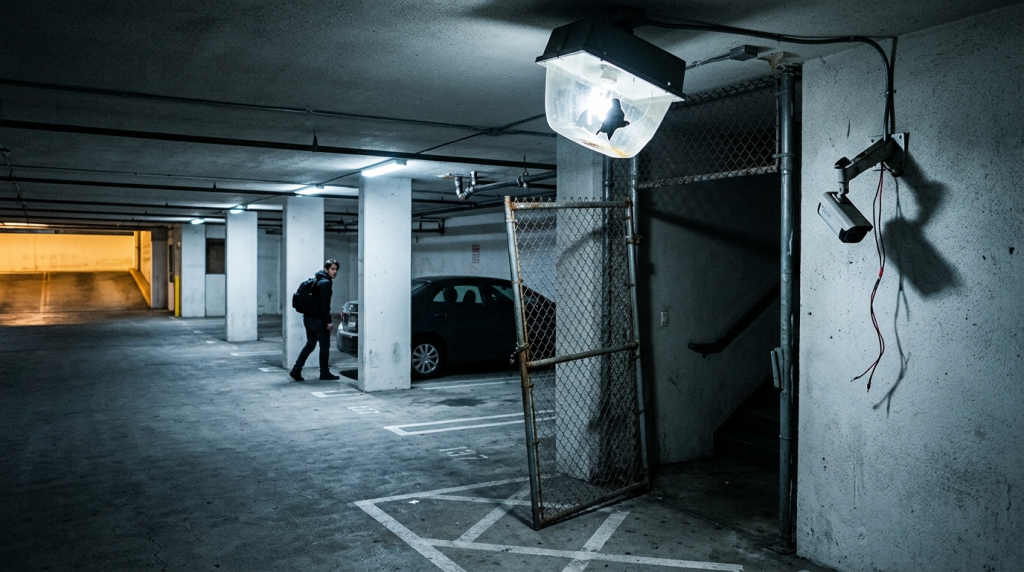
Parking structures around commercial districts and shopping centers present high crime risks due to poor visibility and isolated corners. Common hazards include:
- Dimly lit parking levels and hidden stairwells
- Security cameras that are broken, turned off, or not recording
- Unpatrolled structures with easy public access
- Lack of emergency call boxes or panic buttons
Bars, Restaurants, and Nightlife Venues
Establishments serving alcohol must manage crowds and late-night security risks. Failures include:
- Inadequate security staffing during peak weekend hours
- Failing to intervene during escalating verbal arguments
- Serving visibly intoxicated or dangerous patrons
- Unlit, unmonitored parking areas outside the venue
Hotels and Motels
Hotel operators owe guests a high standard of care. Liability arises from:
- Unreprogrammed keycard locks or faulty room door latches
- Unlocked or unmonitored side emergency exits
- Staff giving out room numbers or keycards to unverified visitors
- Unpatrolled guest corridors
What Does Reasonable Security Look Like?
Once foreseeability is established, the case turns to whether the owner’s safety precautions were reasonable under the circumstances.
Levels of Property Security
Basic Expectations (Required on Almost All Commercial Properties)
- Working deadbolts, window latches, and self-closing gates
- Adequate lighting across entrances, walkways, and parking lots
- Trimmed landscaping to eliminate dark hiding spots
- Prompt repair of broken security hardware
Elevated Risk Measures (Required When Crime Risks Increase)
- Controlled keycard or callbox access for residential buildings
- Functional, continuously recording security camera systems
- Emergency call boxes in parking garages and stairwells
- Formal, written tenant and customer complaint logs
High-Risk Measures (Required When Prior Violent Crimes Exist)
- Uniformed security guard patrols during peak risk hours
- Manned guard gates and visitor check-in desks
- Active safety coordination with local law enforcement
Two critical factors often strengthen a victim’s claim:
- Ignoring Cheap Repairs: Juries respond strongly when an owner refuses to fix a $50 door latch or replace a light bulb after receiving multiple complaints.
- Removing Existing Security: Discontinuing a security patrol or turning off cameras to cut operating costs creates a clear record that management recognized a danger and chose to accept it.
Identifying All Responsible Parties
Recovering fair compensation requires identifying every entity that shared control over the property:
- Property Owners: Hold the primary legal duty to maintain a safe environment.
- Property Management Companies: Handle daily operations, maintenance requests, and physical repairs.
- Security Companies: Can be sued directly if hired guards were sleeping, absent, or abandoning their posts.
- Commercial Tenants: Responsible for security within the specific retail space or venue they lease.
- The Criminal Assailant: Always legally responsible, though often lacking financial assets or insurance.
Under California’s pure comparative fault rule, liability is distributed among all at-fault parties based on their percentage of fault. Our discussion of who is responsible for parking lot safety covers a category that overlaps heavily with negligent security, and our overview of fault when you slip and fall on someone else’s property sets out the broader premises framework.
Why Negligent Security Claims Differ From Standard Premises Cases
Negligent security claims differ significantly from traditional slip-and-fall cases in several key ways:
- Catastrophic Physical Harm: Violent assaults result in gunshot wounds, severe head trauma, facial fractures, stabbing injuries, or fatal harm.
- Severe Psychological Trauma: Crime victims frequently suffer long-term post-traumatic stress disorder (PTSD), severe anxiety, and panic attacks that require ongoing psychological care.
- Weaker Defense Arguments: In slip-and-fall cases, property owners routinely blame the victim for not watching where they walked. That defense rarely works when someone is ambushed by a violent criminal.
- Increased Culpability: Leaving a broken security gate unfixed for months after written complaints shows deliberate indifference to human safety.
Crucial Evidence That Disappears Quickly
The single most important factor in a negligent security case is how quickly your legal team secures physical and digital evidence.
- Surveillance Video: Security cameras routinely overwrite footage within 7 to 30 days. A formal legal spoliation letter must be sent immediately to prevent video destruction.
- Physical Property Conditions: Owners quickly fix broken locks, repair light fixtures, and patch gates right after an assault occurs. Photos and videos taken immediately after the crime capture the true environment.
- Police and Dispatch Records: Local police logs, 911 call records, and crime trend data establish the history of prior similar incidents.
- Internal Business Files: Maintenance work orders, security contracts, guard logbooks, tenant emails, and property management memos reveal what management knew before the attack.
Specific Landlord Duties to Residential Tenants
Because residential apartment attacks represent a large portion of these cases, landlord obligations deserve direct attention. Landlords cannot disclaim responsibility for common areas. If an apartment complex advertises gated entry, secure parking, or night security patrols, tenants pay rent with the expectation that those features work. Common landlord failures in Costa Mesa include:
- Ignoring maintenance requests regarding broken perimeter gates or locks
- Failing to re-key apartment doors between consecutive tenants
- Leaving carport lighting dark for weeks at a time
- Ignoring reports of non-residents loitering in stairwells or drug activity in common areas
If you are a tenant concerned about current safety hazards, always report safety issues to your landlord in writing and keep a personal copy of every communication.
Deadlines for Filing a Lawsuit in California
Failing to file your claim within California statutory timeframes will permanently bar your right to financial recovery.
- Private Property Claims: Personal injury lawsuits against private apartment owners, businesses, or security vendors must be filed within two years of the attack under California Code of Civil Procedure Section 335.1.
- Government-Owned Property Claims: If an assault occurs on property owned by a public entity, such as a city parking lot, public university, or OCTA transit station, strict administrative rules apply. Under California Government Code Section 911.2, you must file a formal administrative claim within six months of the incident.
Frequently Asked Questions
Can I file a claim if my attacker was never identified or caught?
Yes. A negligent security lawsuit is brought against the property owner for failing to maintain safe premises, not against the assailant. Your civil case can move forward even if the criminal is never arrested.
Do I need to wait for a criminal trial to finish before filing a civil claim?
No. Civil personal injury claims proceed independently from criminal prosecutions. Civil court cases also operate under a lower burden of proof, known as a preponderance of the evidence.
The property posted a sign saying “Not Responsible for Crimes.” Does that block my claim?
No. Property owners cannot escape their legal duty of care simply by hanging a disclaimer sign. These signs do not relieve property managers of liability for known security hazards.
How much does it cost to hire a Costa Mesa negligent security attorney?
The Accident Network Law Group handles all personal injury matters on a contingency fee basis. You pay zero upfront costs and zero legal fees unless we win your case and recover money for you.
Action Steps to Take After an Assault on Someone Else’s Property
- Call 911 and File a Police Report: Ensure law enforcement documents the crime and request the official police report number.
- Seek Immediate Emergency Medical Care: Get thoroughly evaluated by medical professionals, even if your physical injuries seem minor initially.
- Report the Incident to Management: Notify the property owner or manager in writing and request a copy of their internal incident report.
- Photograph the Scene Immediately: Take photos of broken locks, unlit fixtures, damaged gates, missing signage, and camera locations before repairs take place.
- Identify Eye Witnesses: Collect names and phone numbers of nearby tenants, shoppers, or bystanders who witnessed the attack or know the property’s crime history.
- Decline Recorded Insurance Statements: Do not provide recorded interviews to the property owner’s insurance adjuster before consulting a lawyer.
- Contact a Legal Team Promptly: Retain legal counsel quickly so formal evidence preservation demands can be served before security video is erased.
Speak With a Costa Mesa Negligent Security Attorney Today
Winning a negligent security case requires proving foreseeability using records that property owners routinely destroy or overwrite. Taking swift legal action protects your rights and ensures critical evidence is preserved. The Accident Network Law Group represents violent crime victims throughout Costa Mesa, Orange County, and Southern California. Our legal team investigates property crime histories, subpoenas maintenance files, secures security camera footage, and holds negligent property owners accountable. Call today or contact us online to schedule your free, confidential case evaluation.
References
- California Civil Code section 1714, responsibility for want of ordinary care
- Ann M. v. Pacific Plaza Shopping Center (1993) 6 Cal.4th 666
- Delgado v. Trax Bar & Grill (2005) 36 Cal.4th 224
This page provides general information about California law and is not legal advice for any specific situation.